
A practical reliable device designed to measure the state and timing of glottal opening and closing during speech is not currently available for use in phonetics labs but such and instrument is highly desirable. As with other articulators such as the lips, it is important to know the state (open, closed, partly open) and the timing of the transition towards that state.
The Laboratoire de Phonétique et Phonologie (LPP), Université Paris has developed an external Photoglottograph (ePGG) system. It operates by illuminating the glottis through the neck skin with an infrared light and recording light variation intensity modulated by glottal movement with a photodiode placed across the larynx. The concept is not new. Indeed development of light based glottal measurement instruments has been proposed more than 60 years ago. We have built a version of the LPP system based on infrared LEDs and photoreceptors and integrated and synchronised it with speech audio, ultrasound and EMA within AAA. It records approximately 3kHz which permits analysis of vocal fold oscillations as well as the slower glottal opening gesture.
The glottal aperture data recoded by our ePGG can be charted along with lingual measures to reveal relative timing.
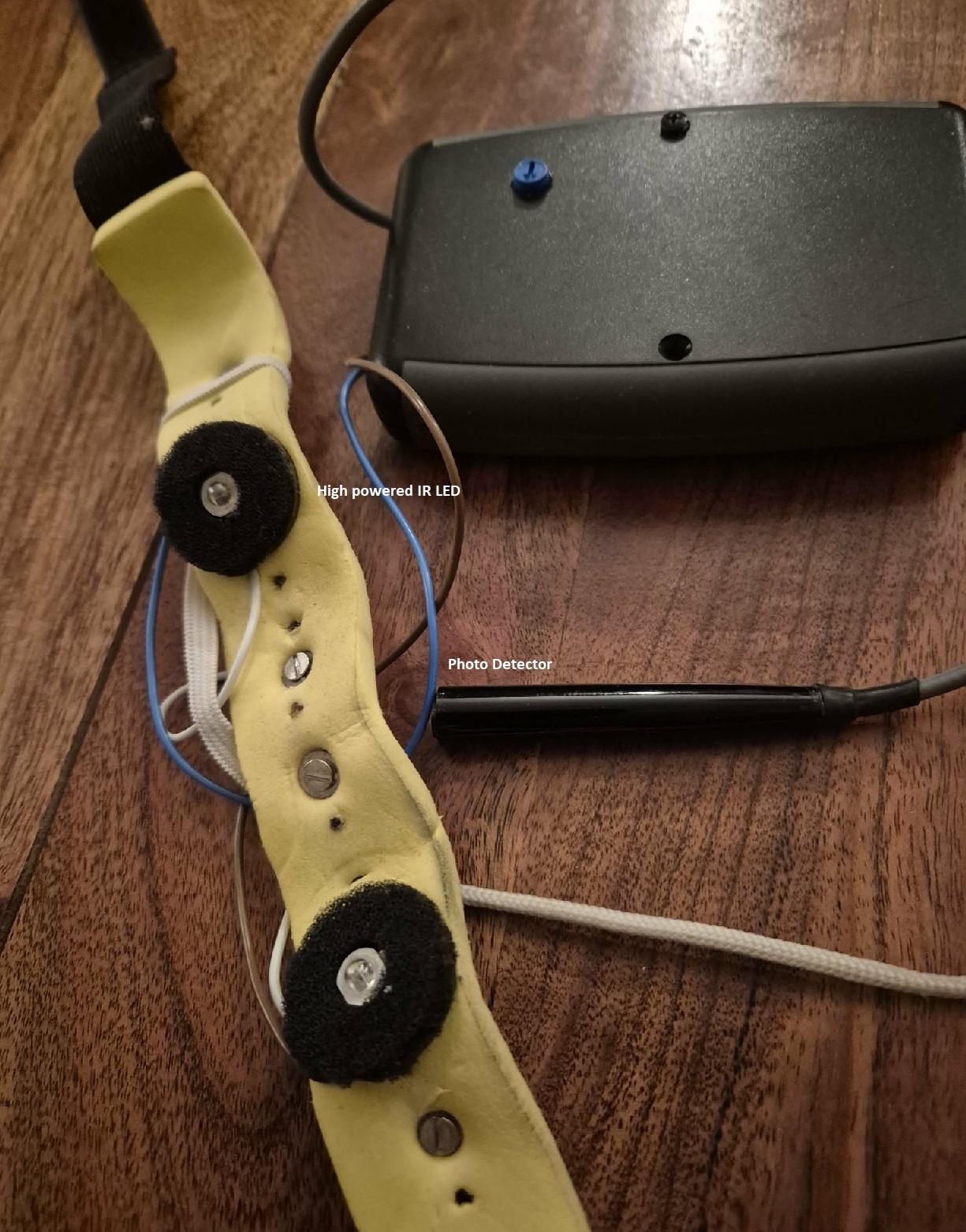
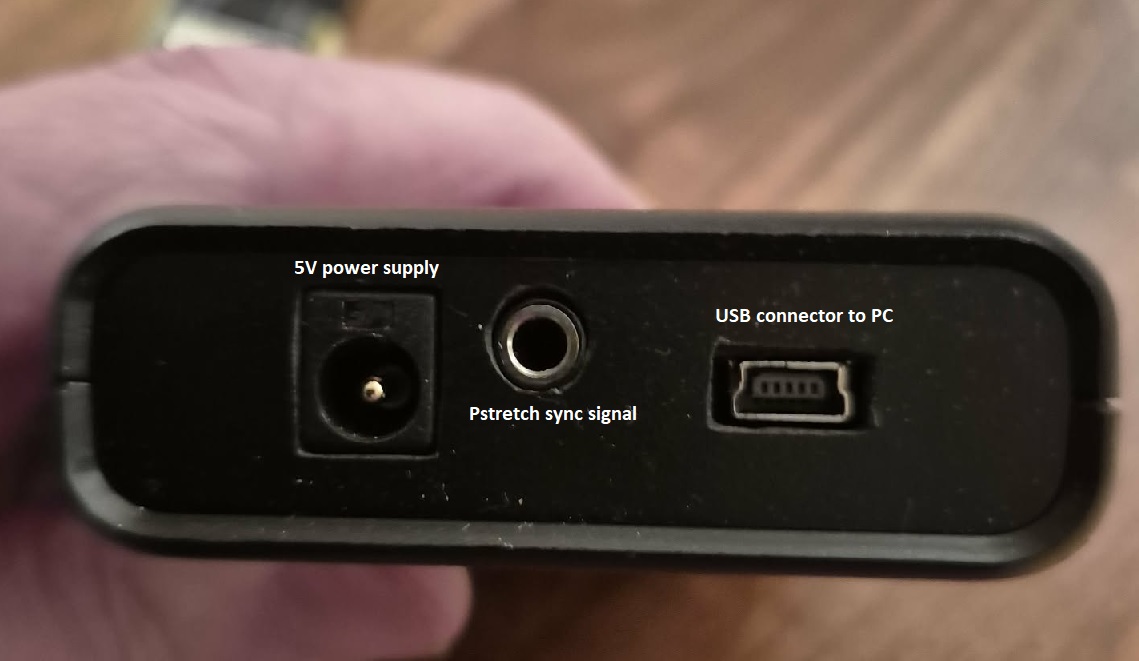
The prototype reveals challenges unique the the measurement of glottal opening as opposed to vocal fold vibration, for which it is largely utilised. The source light must be shone through the thyrohyoid membrane between the thyroid cartilage and the hyoid and lateral to the thyrohyoid muscle. However, the larynx will raise and lower for certain speech targets and the gap between hyoid and thyroid may vary. Locating the photoreceptor reliably is even more challenging as the gap between thyroid cartilage and cricoid cartilage is small and subject to variating during larynx raising and lowering. These are significant design challenges to be overcome before a reliable instrument can be produced.
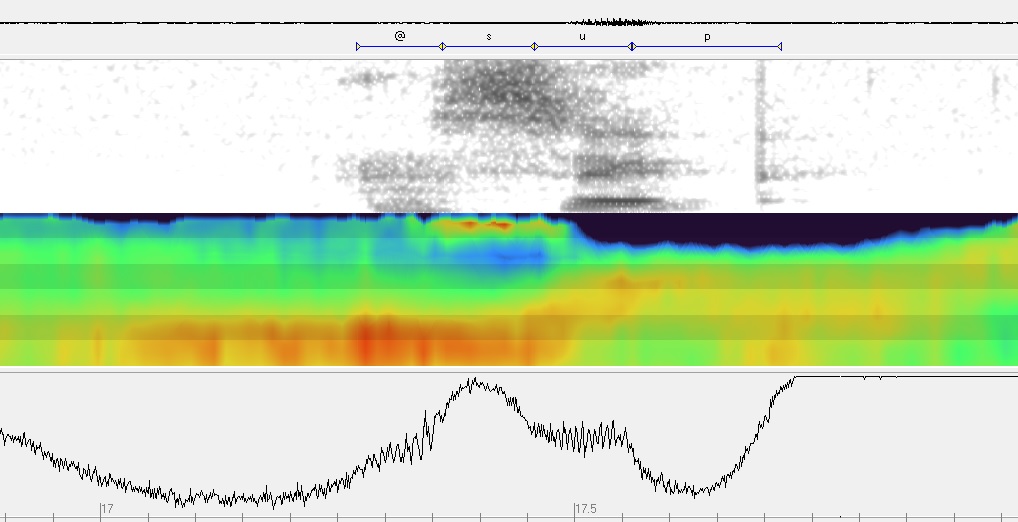
Here is an example of an ePGG signal carefully recorded for the phrase “A soup” The glottis closes in preparation for the schwa, then opens half way to permit the vocal folds to vibrate and the oscillation of the folds can be seen. After the vowel, the glottis opens further to stop the phonation and provide airflow for the /s/. Then it closes halfway to allow phonation for the /u/. Finally the glottis closes to stop the phonation and for the initiation of the /p/ closure and opens rapidly for the /p/ burst release. The clipped top is because the glottis opens wider for a breath at the end of the phrase. Note that the schwa phonation occurs as the glottis widens slowly and smoothly from the closed to open positions. The schwa is consequently part of a transitional glottal movement towards the /s/ target. Note also that that the closure proceeding the schwa is commonly termed glottalization but in this case it is not detectable from the acoustic signal.
A. Bouvet, A. Van Hirtum, X. Pelorson, S. Maeda, K. Honda, and A. Amelot, “Calibration of external lighting and sensing photoglottograph,” 10th International Workshop Models and Analysis of the Vocal Emissions for Biomedical Applications (MAVEBA), Florence, Italy, 2017
A. Bouvet, A. Amelot, X. Pelorson, S. Maeda, and A. V. Hirtum, “External lighting and sensing photoglottography: Characterization and MSePGG algorithm,” Biomedical Signal Processing and Control, vol. 51, pp. 318 – 327, 2019
K. Honda, and S. Maeda, “Non-invasive photoelectroglottography method and device,” U. S. Patent 2010/0256503, Oct. 7, 2010.